
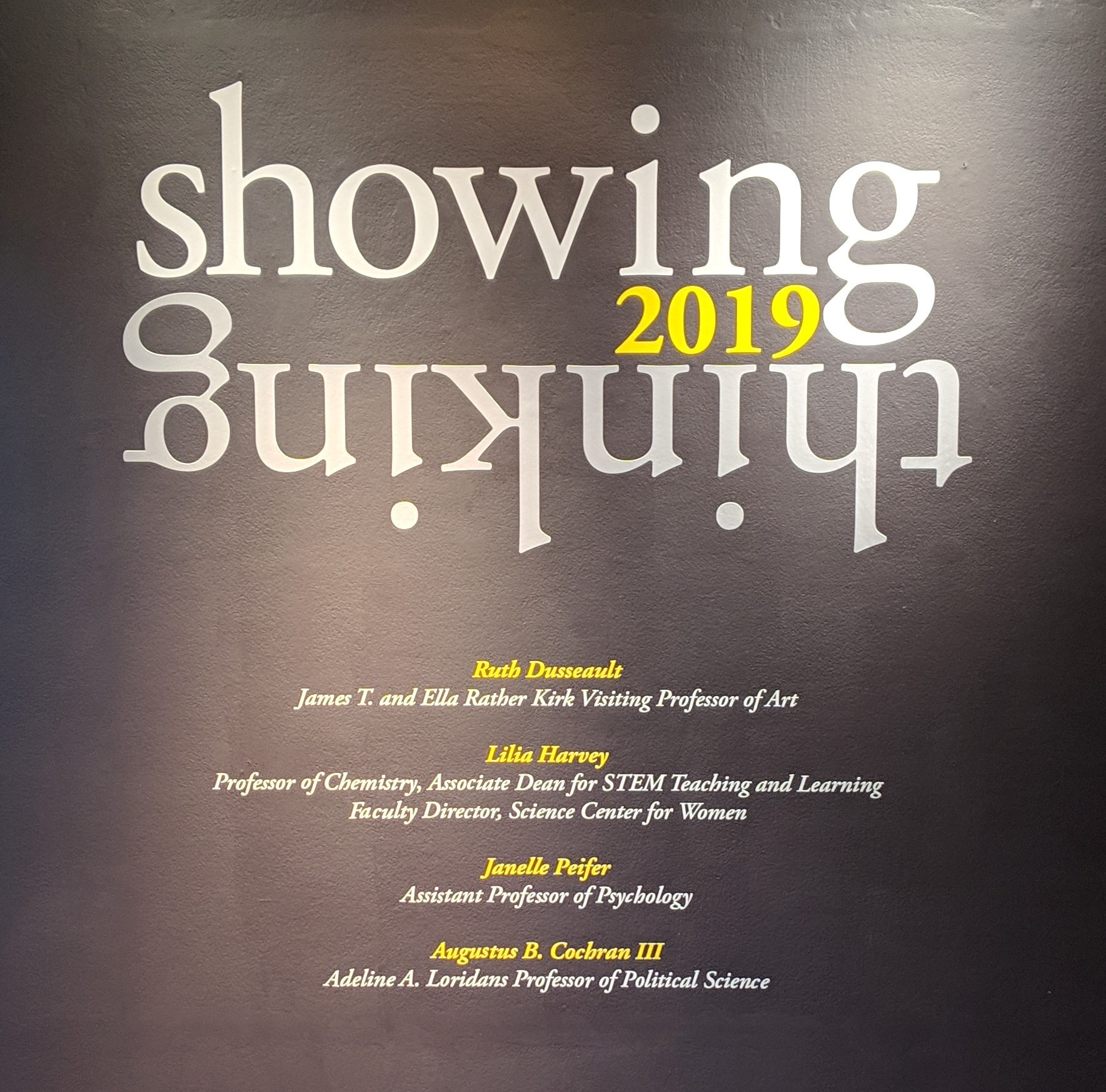
In April of 2019, the seventh annual Showing, Thinking exhibition took place at the Dalton Gallery in Decatur, Georgia.
Every year, Showing, Thinking showcases the inner workings of four chosen professors at Agnes Scott College. They are asked to be vulnerable, providing the team of curators with their highly sensitive possessions. Past artifacts include: sketchbooks, failed ideas folders, a baking mixer, running shoes (used when going on “thinking” jogs), an entire chalkboard filled with math equations, and single sheets of paper with scribbled, fleeting thoughts that covered a gallery wall from top to bottom. This exhibition puts value on the journey rather than the destination as it creates atmospheres from the past, present and future that all feel ongoing. Some professors may reflect on their inspirations and past experiences while others would focus on displaying their current projects, sometimes loaning every item on their desk to the gallery so viewers can be in their simulated working environment.
This year, four professors of Agnes Scott College visualize their thought processes: Ruth Dusseault (Visiting Professor of Art), Lilia Harvey (Professor of Chemistry, Associate Dean for STEM), Janelle Peifer (Assistant Professor of Psychology) and Augustus B Cochran III (Professor of Political Science).
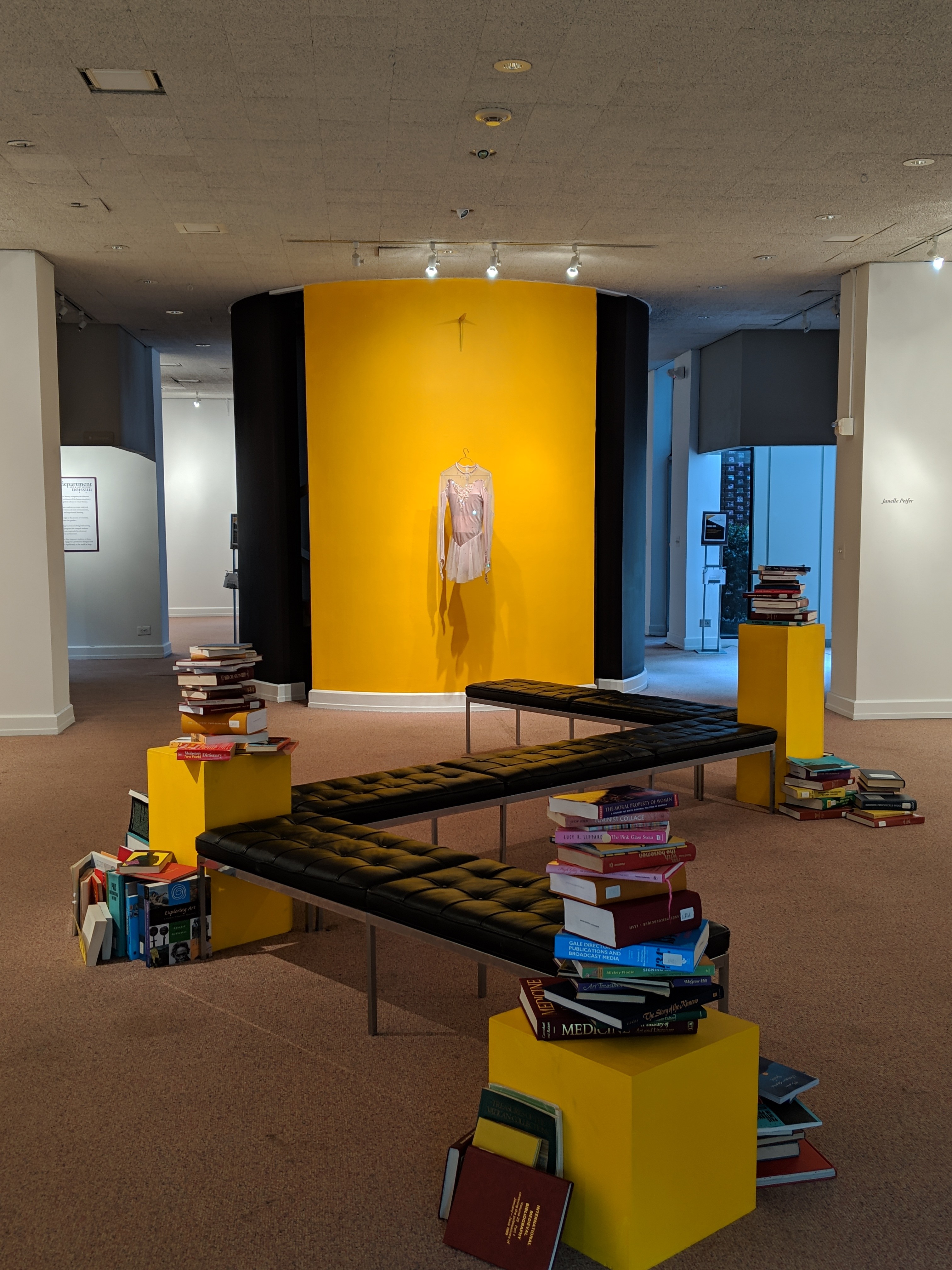
Each year, a team of curators choose a unique accent color for the exhibition, and this year was a bright sunshine yellow. The color is drawn from a commonality among the professors. For this exhibition, both Professor Janelle Piefer and Professor of Chemistry Lilia Harvey favored this color in their loaned artifacts and in the clothes they wore during the portrait photo shoot for the exhibition.
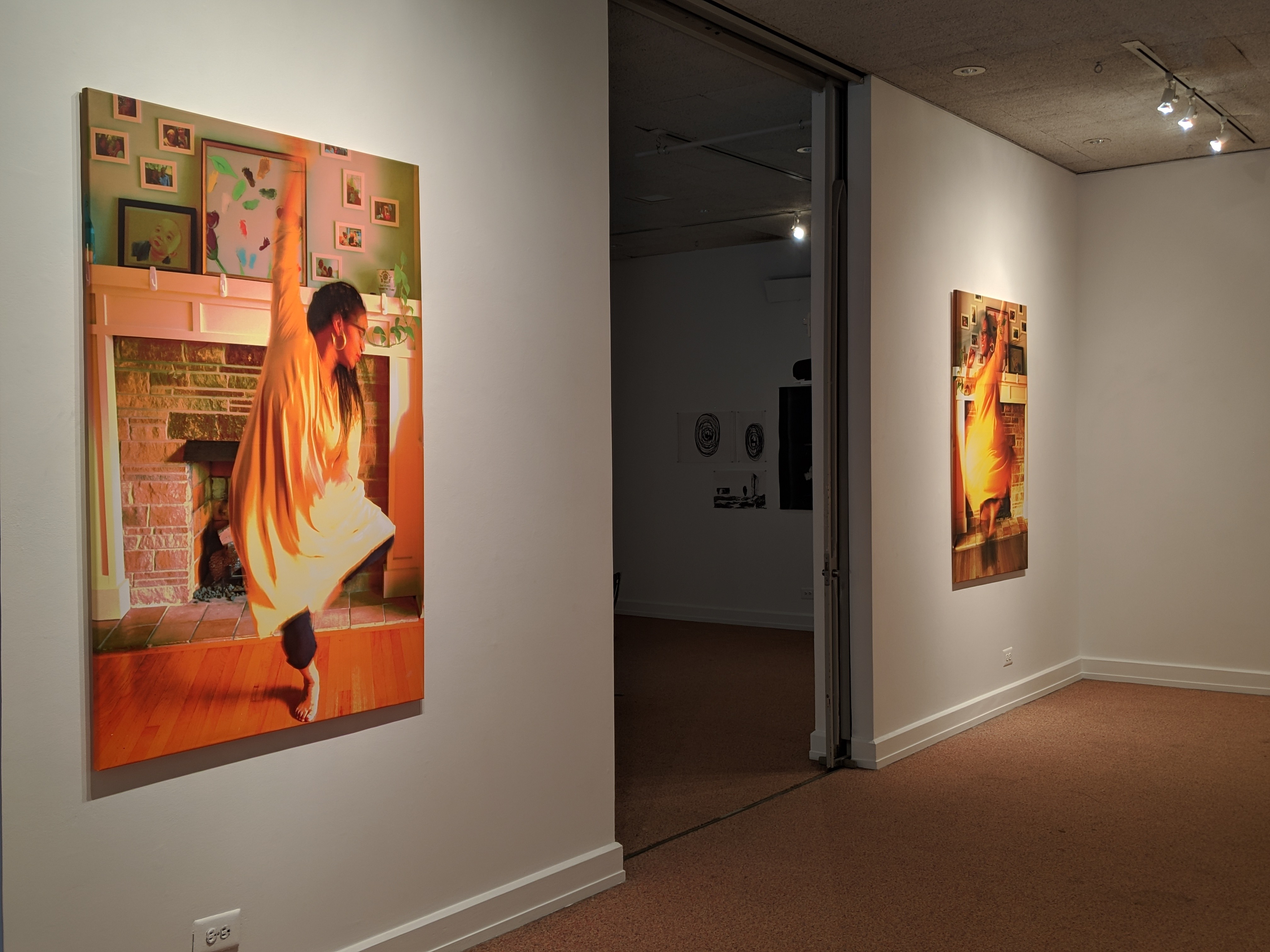

Professor Piefer’s room, doubling as the entrance of the gallery, embodies different types of movement– from the movement of shadows in the leotard to the perceived movement in the yellow images of her. Atop a stack of three books and a sunflower yellow stand, there is a small television monitor that loops home videos of Piefer dancing as a child.

Visiting Professor of Art Ruth Dusseault’s room was purposefully stripped of color to offer a minimalist, 20th century experience. Vintage Van der Rohe chairs provide seating in front of two side by side projection screens. The left projection presents the French documentary Le Joli Mai (d. Chris Marker & Pierre Lehume, 1962). As a comparison, a slide show on the right projection loops the book Evidence by Mandel; Sultan (1977) documenting industrial and scientific evidence from private and public collections. On the far right wall, Dusseault’s sketches uphold the black and white aesthetic of the room– participating in a handcrafted, time warped utopia.
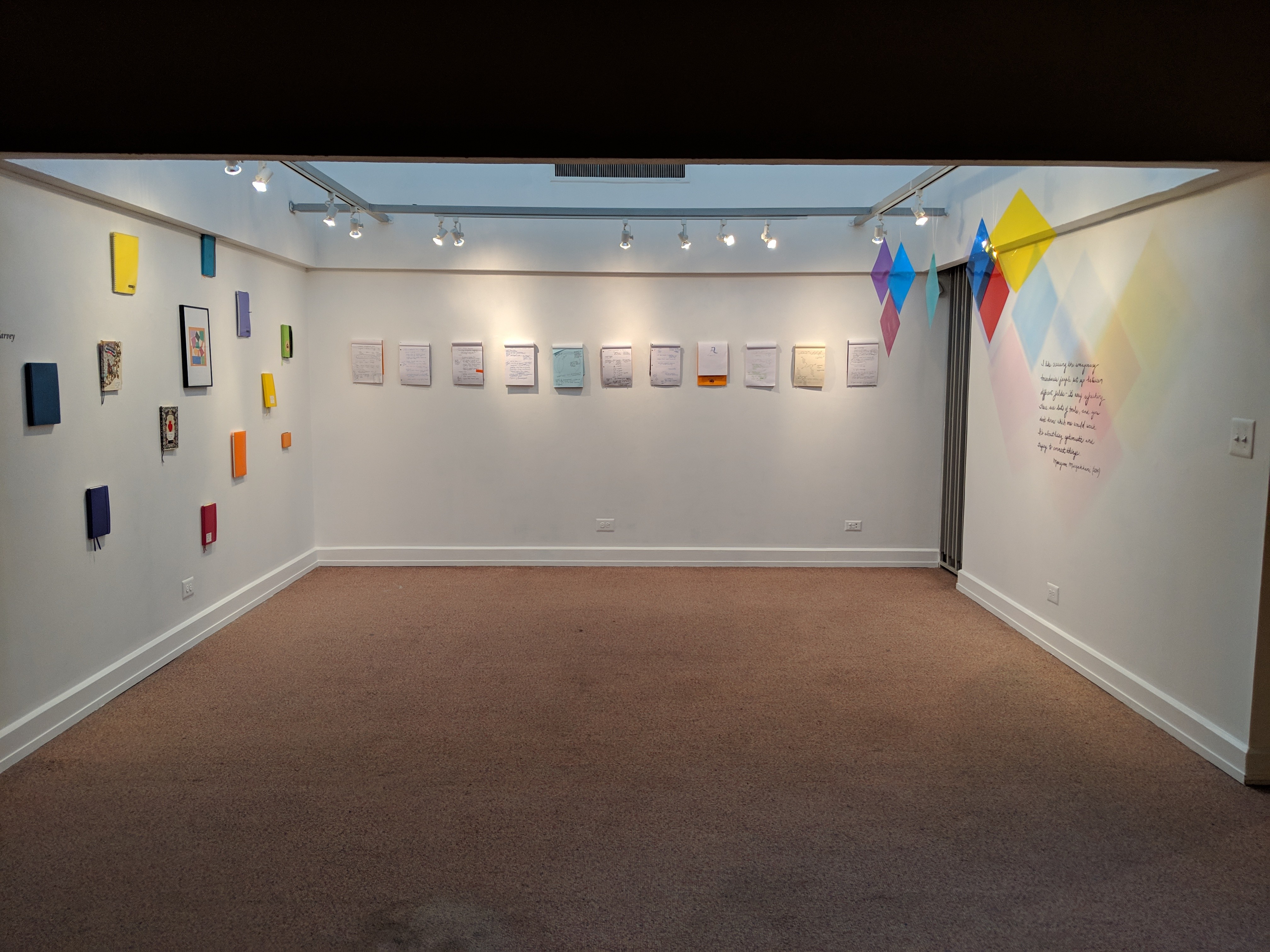

Vibrant colors were the theme in Professor of Chemistry Lilia Harvey’s room. Each notebook that she loaned to the gallery was a different bright color, so we asked Professor Harvey to loan one of her framed art pieces to act as the center piece for the bold moleskin notebooks. In a slightly more vulnerable tone, Harvey gave us permission to open some of her notepads and display her notes. Details of the notes included drawings, while some ideas were written in multiple languages. The wall with the quote was given a pop to the upbeat room, hanging gel squares from the ceiling so that the light can reflect color onto the wall.
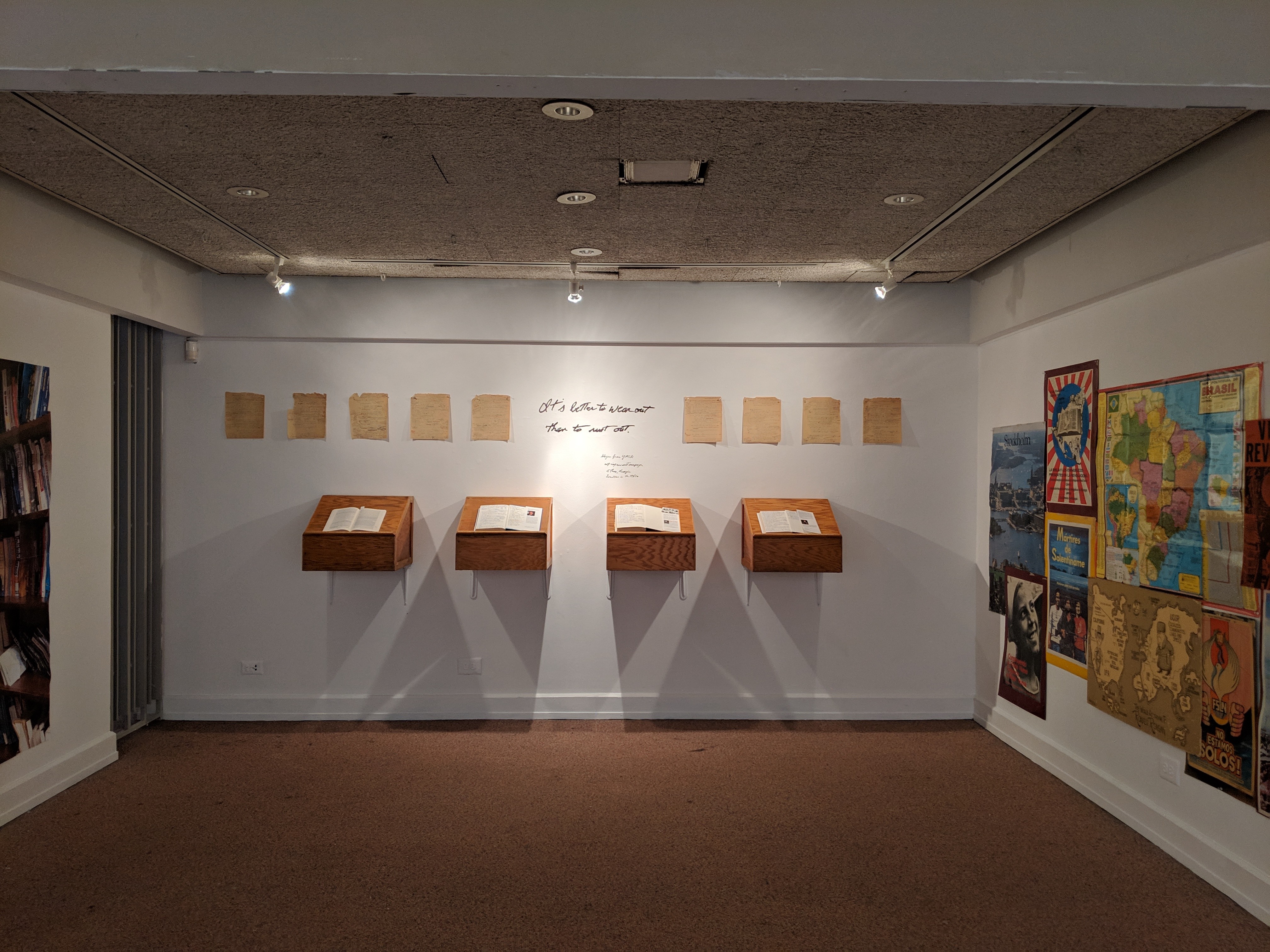
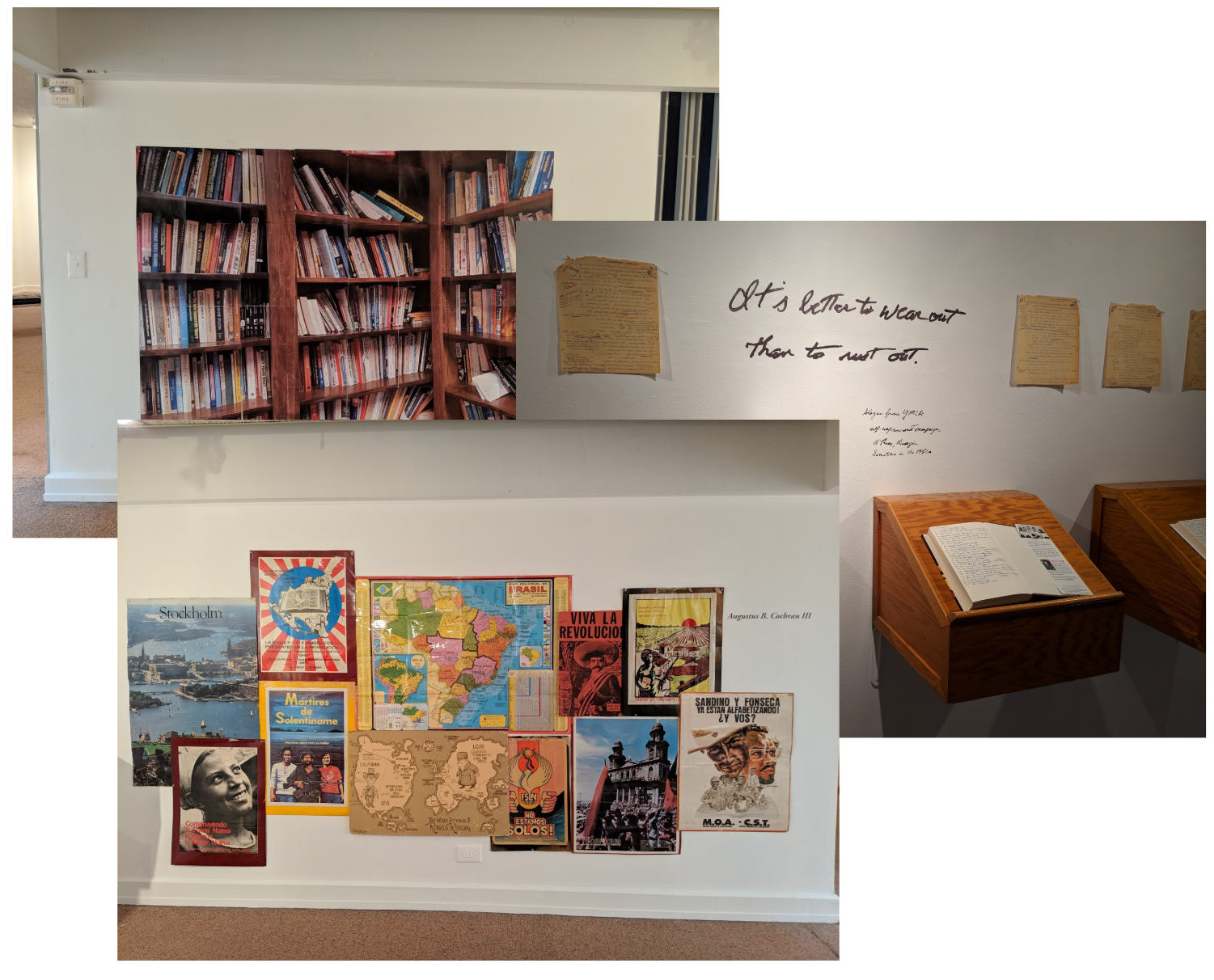
Professor of Political Science Gus Cochran’s room represents his profession. A life size section of his bookshelf is printed on the wall as the visitors step into the mind of someone well traveled and interested in politics around the world. Some of Professor Cochran’s published articles rest on suspended podiums, while his aging notes hang above them. His posters from different countries come together in a collage to tell a story of how the world is connected.
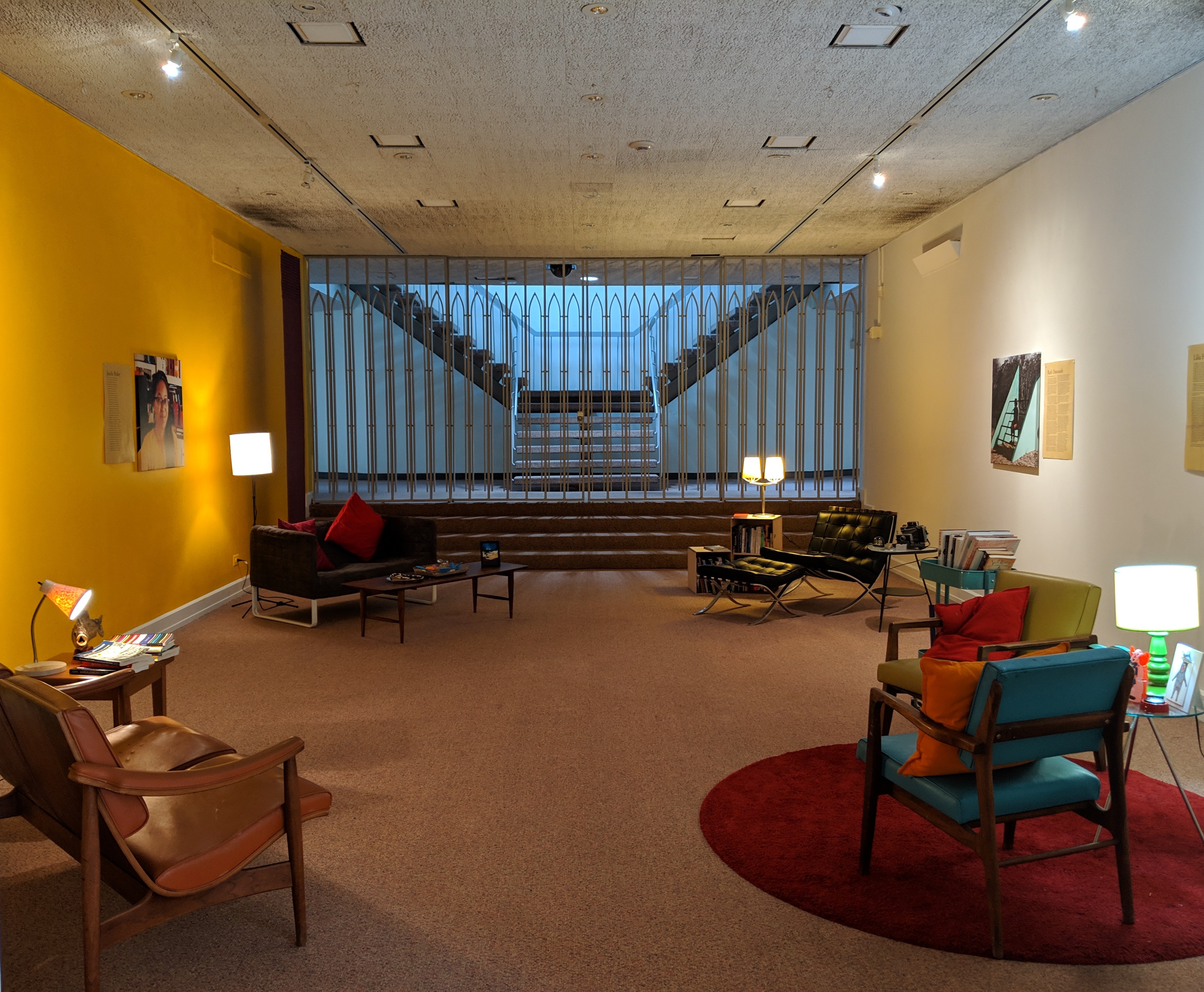
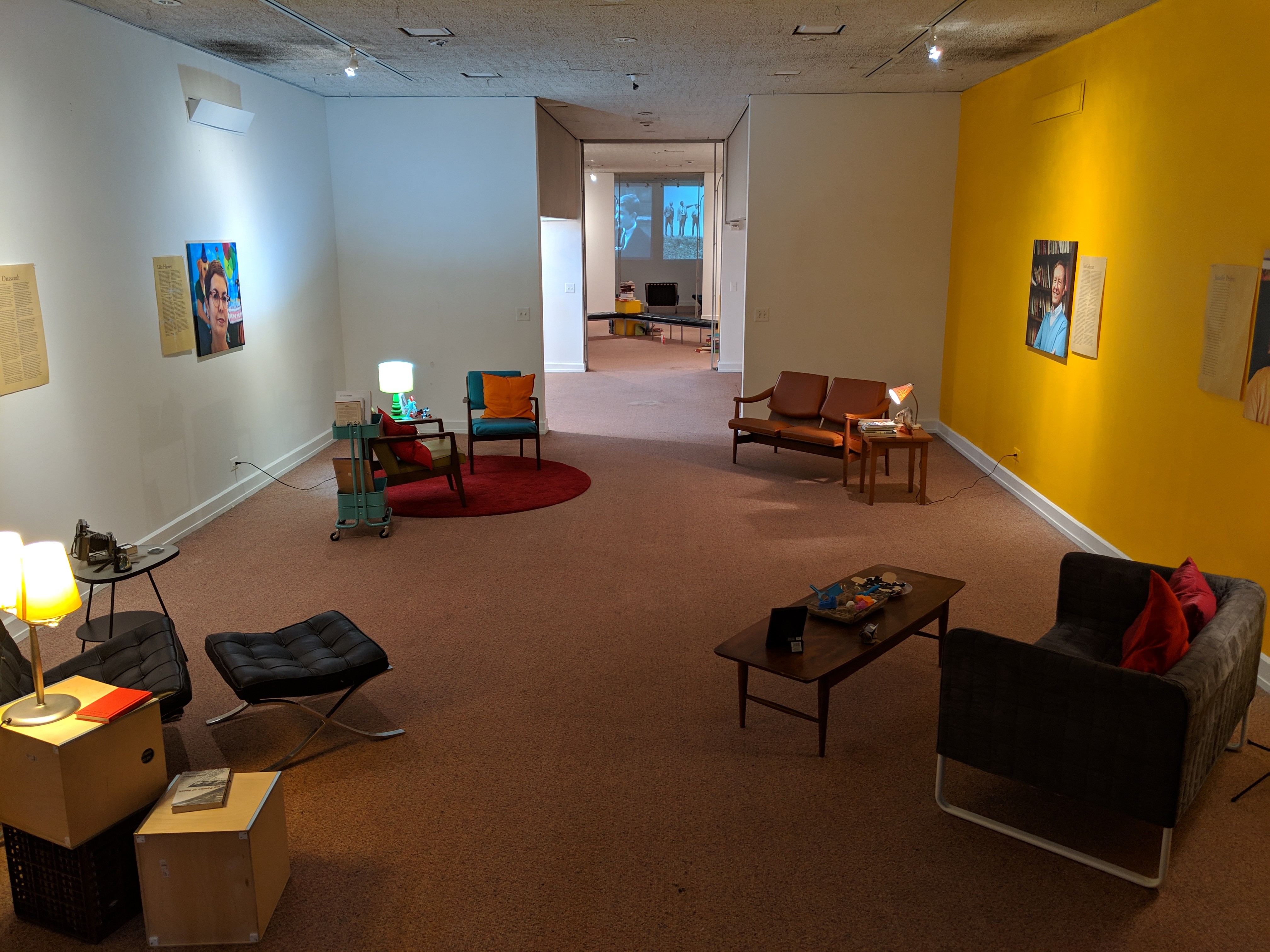
This exhibition was held in five rooms within the gallery– one for each professor and a community room where each corner of the room is a reading nook that represents a professor. Harvey has vivid decor, Cochran has subtle neutral tones with some items from his office desk, Dusseault mimics her room with a Van der Rohe mid 20th century chair, and Piefer has a coffee table with a sandbox in the center, giving a nod to her identity as a mother. The community room combines the four aesthetics to create a space for visitors to interact with the professors and with each other. Behind each area stood an artist’s statement by each professor as well as a portrait of them. Although this is likely the last room that visitors will encounter, the statements and portraits put a face and their own words to their rooms, provoking visitors to go back and take a second look at who exactly harbored these ideas and inspirations.
The task of exposing one’s process, whether chaotic or collected, is not easy. However, the individuals that participated in this exhibition showcased their visions and motivations, often living beyond their professional fields. The Showing, Thinking exhibition once again held a space for happenings of the everyday ceaseless mind.
I was so excited to have been a part of the curating and preparation teams and to be sharing it now. Many more exhibitions to share and participate in.
Your Curator, Ken
 Kennedy
Leave a comment